Waterworks2025

The brief asked
the wrong question.

Waterworks, a $188M luxury bath and kitchen brand, extended into custom cabinetry a decade ago. Parsons' External Engagement Studio put that segment to a student team, with the founder and senior leadership as the client. The recommendation was to close it.
Waterworks
The brief

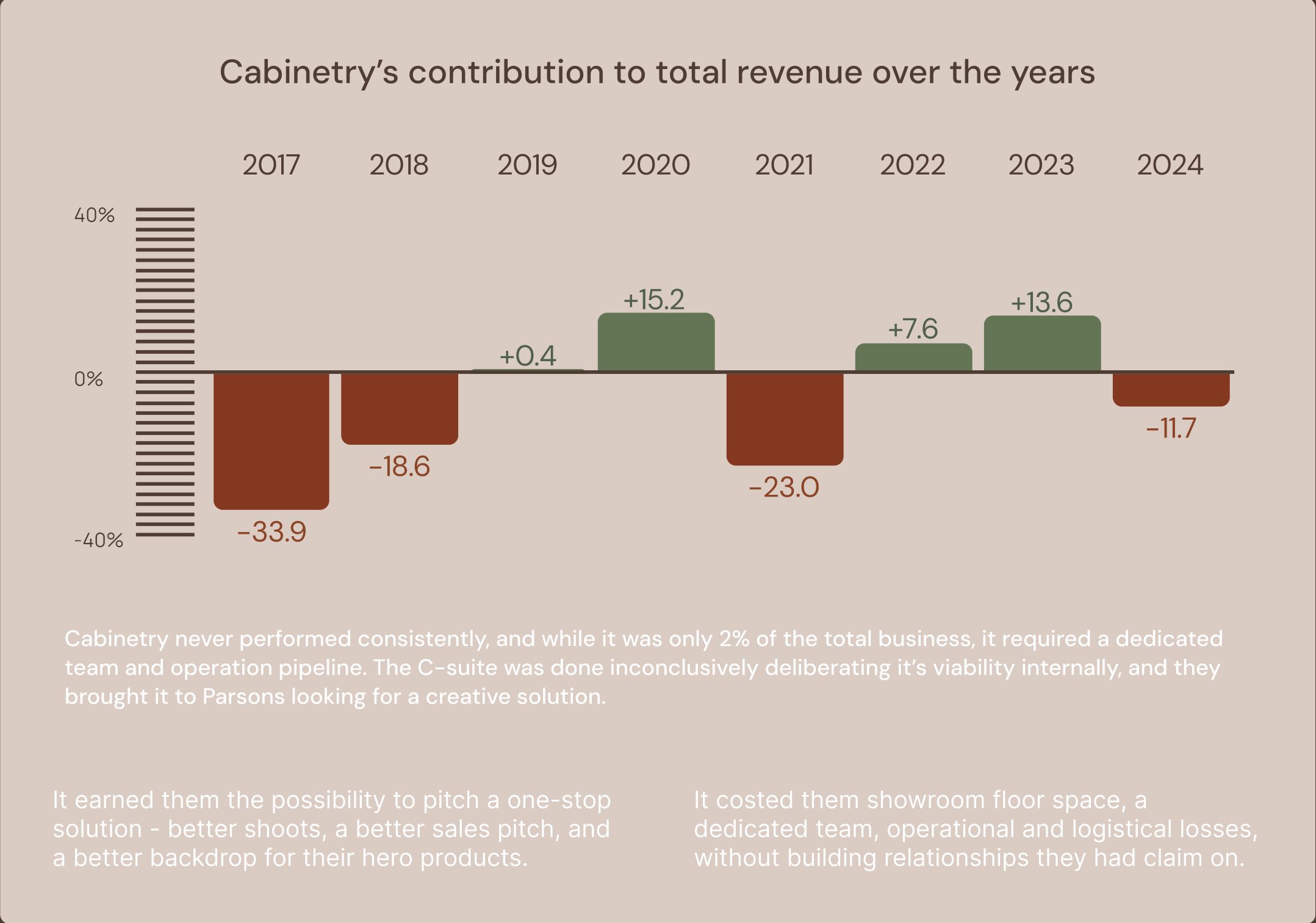
Ten years ago Waterworks extended its fittings and hardware into full custom kitchens and baths. A decade in, cabinetry was 3% of sales and had never turned consistent profit.

The brief asked three questions: reimagine the business model, measure the intangible value cabinetry brings the brand, improve long-term profitability.

Cabinetry's contribution to revenue
The finding

The team interviewed the C-suite executives and the floor managers about fittings and cabinetry, then mapped the parent business and the cabinetry division as two business model canvases, side by side.

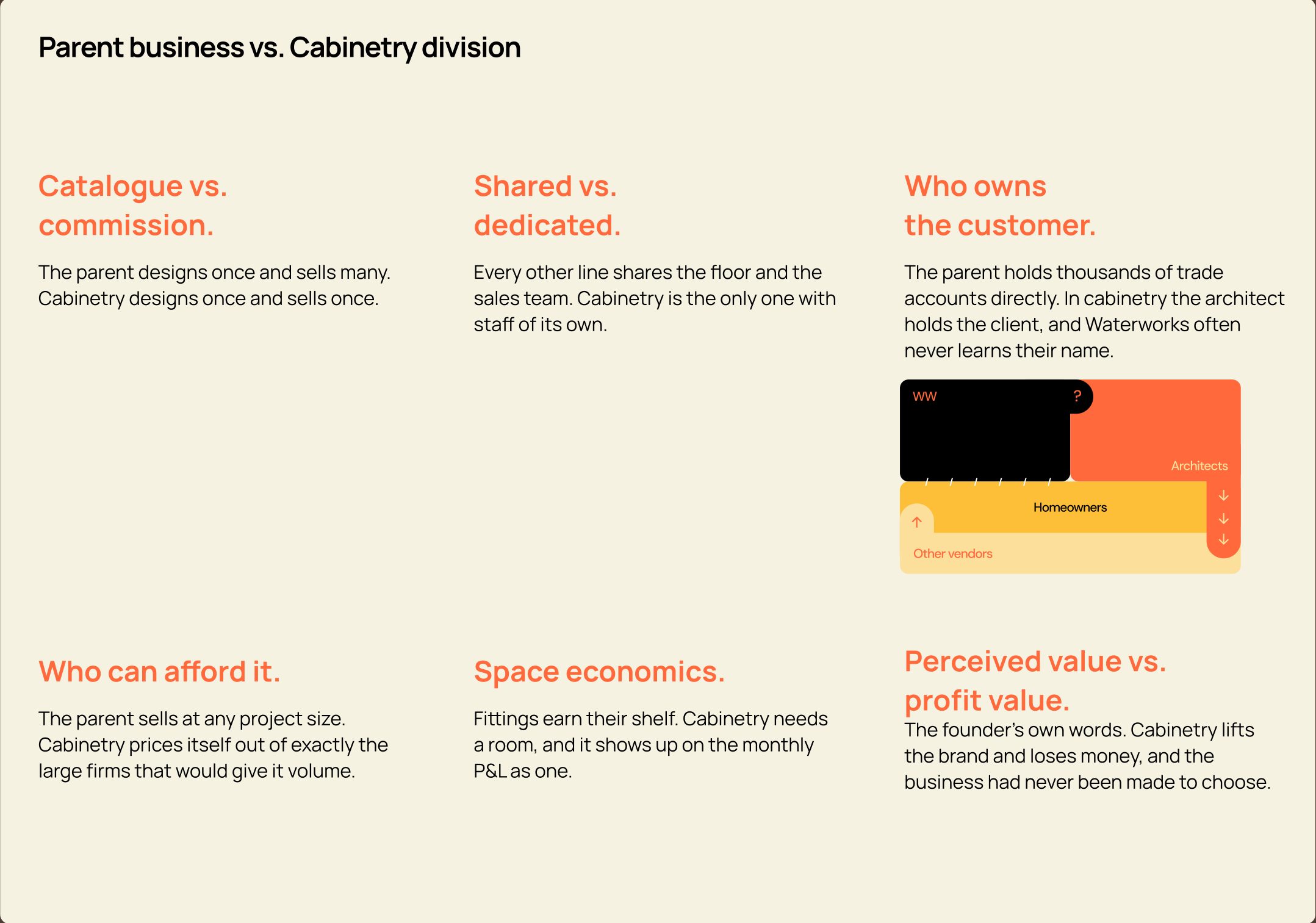
They were not the same business. Fittings sell from a catalogue to the trade. Cabinetry is bespoke per project, needs staff of its own, and the client belongs to the architect.

Quote
Parent business vs cabinetry division
Insight

The brief asked how to fix cabinetry. In one workshop, the client questioned the same thing in different versions: "should we be in cabinetry at all?"

The work

The team built the case for exit, against growth and against break-even.

Masco, which left a $950M cabinetry business and came out with better margins, was the precedent that let exit go forward as a refocus rather than a retreat, the only version leadership could act on.

Visual to come (deck slide is a video or still blank).
My role

I ran the product-director interview and built the canvases that exposed the misalignment. The team and I pressure-tested all three routes, and the recommendation was the team's call.

The process

Half the semester went into solving the wrong problem. At the midterm the team was still asking how to make cabinetry a signature Waterworks product.

The founder had already named it in his interview: a disconnect between perceived value and profit value. It was in the notes, and the team kept designing around it.

When questions about resource reallocation reached staff, leadership asked for the subject to be handled with discretion. That is when it stopped being an exercise.

Needs the sorted workshop bullseye screenshot (see GAPS.md).
The outcome

A phased exit across four quarters, closing with the design IP archived rather than discarded, so re-entry stays possible without owning the operation.

Found: a −11.7% contribution margin on $3.5M of revenue, against a $5.7M target.

Projected: $850K less overhead a year, EBITDA up 2.5 points, ROIC from 7% to 12% over five years, benchmarked on Masco.

Presented to the founder and senior leadership, and received positively.

Visual to come (deck slide is a video or still blank).
Credits

More work

View All
Mul Secrets
Brand Strategy, Packaging and Art Direction
Fenty x Nykaa
Concept and Art Direction
Articurate
Research, Product Strategy and Design